
Solar Irrigation Pump System: Components, Sizing and Buyer Checklist
A procurement-focused guide to defining water demand, total head, solar resource, pump performance, storage, controls and supplier deliverables.
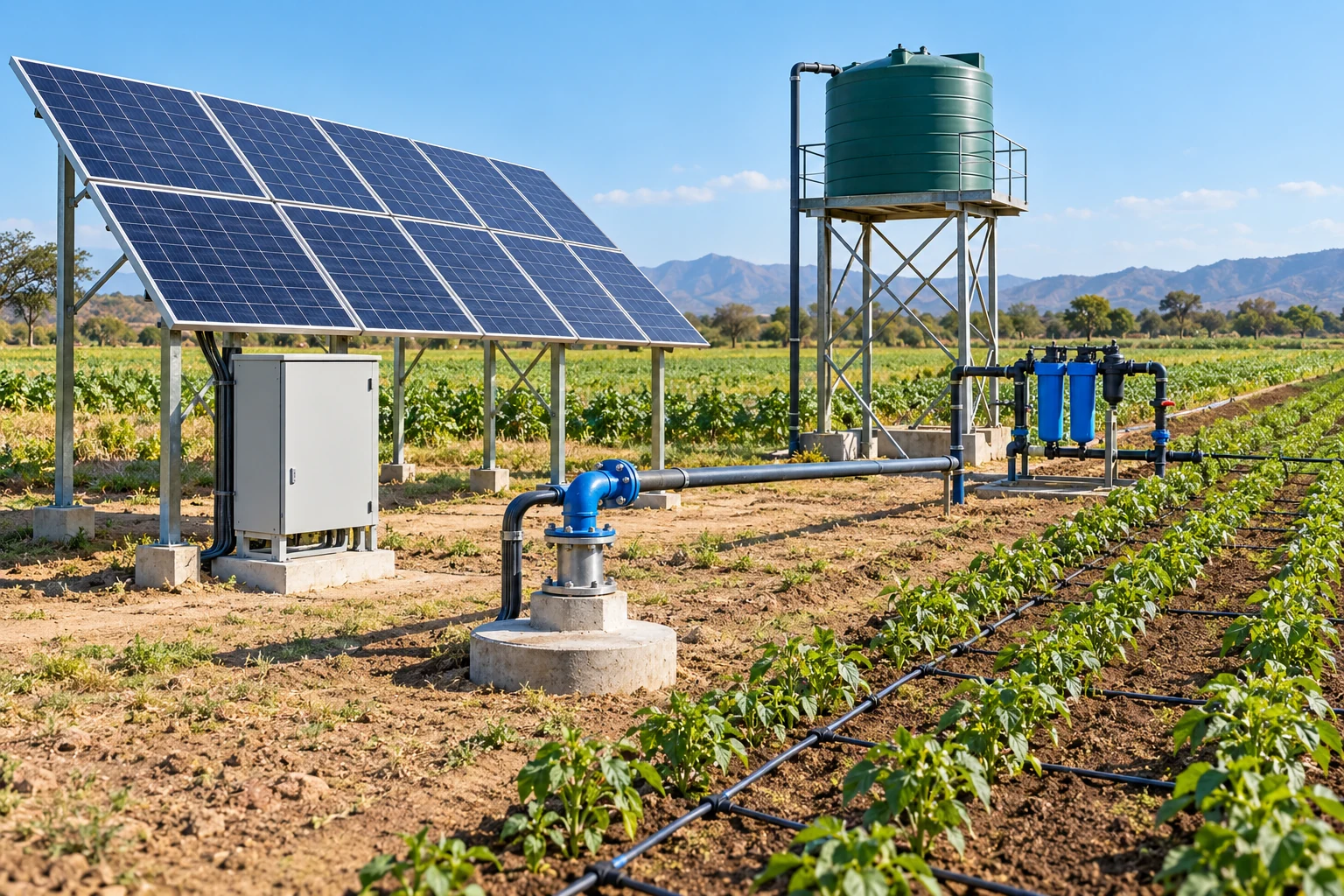
A solar irrigation pump system is more than photovoltaic panels connected to a water pump. It is a coordinated hydraulic and electrical system designed to deliver a required volume of water under the solar conditions of a specific site.
Buyers often receive quotations that use the same label but include very different scopes. One may include only panels, controller and pump; another may include mounting, sensors, piping, filtration, water storage, installation and commissioning. A reliable comparison begins with common design data and a written system boundary.
This guide explains the information international buyers should prepare and the documents suppliers should provide. Final hydraulic, structural and electrical design should be completed and checked by qualified professionals under destination-country requirements.
What a complete solar irrigation system includes
The core power train contains a PV array, mounting structure, pump controller and motor-pump unit. The balance of system connects those components safely and turns pumped water into useful irrigation.
- PV modules: generate direct-current electricity from solar radiation.
- Mounting structure: supports the modules at the specified orientation and design loads.
- Pump controller or inverter: matches variable PV output to the motor and manages starting, speed and protection.
- Surface or submersible pump: supplies the required flow at the calculated total dynamic head.
- Electrical balance of system: cables, connectors, isolators, overcurrent and surge protection, earthing and enclosures.
- Hydraulic balance of system: intake, rising main, valves, check valves, pipes, fittings, gauges and flow meter.
- Water storage: reservoir or tank where the operating plan requires separation between sunny pumping hours and irrigation time.
- Irrigation head and network: filtration, pressure regulation, fertigation where applicable, zone valves and field distribution.
- Monitoring and sensors: water-level, dry-run, tank-level, pressure, flow and system-performance monitoring.
The World Bank solar-pumping guide notes that mounting, wiring, switches, fuses, piping, meters, data logging, engineering and installation form a material part of the project—not optional details.
Data required before sizing
Three inputs sit at the centre of preliminary solar-pumping sizing: daily water requirement, total pumping head and solar resource during the design period. They must be supported by field data rather than assumptions.
Daily water requirement
Estimate crop water demand for the critical month, then include irrigation efficiency, operating pattern and any livestock or domestic demand within the authorised system scope. State the required cubic metres per day and how that requirement varies by month.
Total dynamic head
Total head includes the vertical difference from the pumping water level to the delivery point, required pressure at the irrigation system and friction losses through pipes, valves, filters and fittings. For a borehole, use the pumping or dynamic water level—not only the static level.
Design-month solar resource
Use site-specific or appropriately representative solar irradiation for the month when the relationship between available solar energy and water demand is most demanding. Annual averages can hide seasonal shortfalls.
Water-source capacity
Confirm sustainable well yield or seasonal surface-water availability. The system must not be sized to pump more water than the source can reliably provide. Also test water quality for sand, suspended solids, salinity and other conditions relevant to pump materials, filtration and irrigation equipment.
The Solar Powered Irrigation Systems Toolbox recommends collecting meteorological, site, crop, soil and water information because incomplete site evaluation commonly produces under- or oversized systems.
Choose the system configuration
| Configuration | How it works | Key buying questions |
|---|---|---|
| Direct solar pumping | Pump feeds the field while solar energy is available | How will varying flow and pressure be managed across irrigation zones? |
| Solar pumping to storage | Pump fills a tank or reservoir; irrigation operates separately | What usable storage volume, elevation, overflow and level control are required? |
| Solar-grid hybrid | Grid supports operation when solar power is insufficient | Which source is primary, and how does switching and protection work? |
| Solar-diesel hybrid | Diesel provides backup or peak support | Can the controller coordinate both sources and document expected fuel savings? |
Direct pumping can reduce equipment count but solar irradiance changes during the day. That variation must be compatible with the pump, zones and application method. Storage can provide steadier irrigation and extend operating time, but it adds civil work, water losses, land use and structural requirements.
Our diesel vs electric vs solar irrigation pump comparison covers power-source selection and lifecycle-cost trade-offs in more detail.
Select the pump from the duty—not panel wattage
Specify the required flow and total dynamic head, then ask suppliers to show the operating range on the exact pump curve. For a borehole, confirm casing diameter, dynamic level, installation depth, cable length and permitted sand content. For a surface source, confirm suction arrangement, priming, intake protection and real suction conditions.
The motor-pump should operate efficiently across the expected solar-powered range, not only at one noon design point. Ask for flow-versus-head and flow-versus-power information, motor type, speed control, efficiency, materials, seals and maximum starts.
A proposal based only on pump horsepower, outlet size or maximum flow is incomplete. Use our flow, head and power guide to prepare the hydraulic duty first.
Specify the solar array, structure and controller
The array must deliver enough usable energy under design-month conditions after considering temperature, dust, wiring, controller and other losses. Ask the system integrator to state the solar data source, loss assumptions, module orientation and predicted daily water delivery by month.
Module quotations should identify manufacturer, exact model, rated power, quantity, electrical configuration, certifications, product warranty and performance warranty. Verify that the selected controller’s voltage, current and motor compatibility match the complete array and pump.
The mounting structure needs a documented material, coating, foundation and design basis for local wind, corrosion and soil conditions. Electrical scope should show cable type and size, connectors, isolation, overcurrent protection, surge and lightning strategy, earthing, enclosure ratings and safe access. Local qualified professionals should approve the final design.
Use water storage deliberately
Many solar irrigation systems store water instead of electricity. A reservoir or elevated tank can accept variable daytime pumping and release water according to the irrigation schedule. This can avoid the cost, maintenance and replacement requirements of batteries.
Storage is not automatically necessary or automatically cheaper. Size usable volume from the water balance: expected solar pumping, irrigation timing, reserve requirement and permitted source abstraction. Confirm tank elevation against the pressure needed after pipes, filters and valves. A gravity tank that is too low may not provide adequate pressure for the distribution system.
Specify inlet, outlet, overflow, drainage, level sensors, dry-run interlock, access, water-quality protection and structural support. Include local civil and structural design rather than assuming the equipment supplier’s standard stand suits every site.
Match the irrigation network to solar operation
Drip irrigation can suit solar pumping because it often uses lower operating pressure, but it requires reliable filtration, pressure control and emitter maintenance. Sprinklers may require more pressure and are affected by wind and nozzle overlap. Read our drip vs sprinkler irrigation guide before locking the distribution design.
Divide the field into zones that the pump and available solar power can serve reliably. Confirm pipe diameters, lateral lengths, pressure variation, filter loss and elevation. If direct pumping causes variable flow, the designer should explain how zone valves, pressure-compensating devices, a variable-speed controller or storage will keep application acceptably uniform.
Do not let suppliers size the PV array and pump independently from the field network. Avoidable pressure loss in undersized pipes or dirty filters increases the energy requirement and can enlarge the entire solar system.
How to compare supplier quotations
Send one written request for quotation to every supplier and require a line-by-line compliance response. Compare these fields:
| Quotation item | Required evidence |
|---|---|
| Design basis | Daily water demand, design month, solar dataset, dynamic water level and total head calculation |
| Predicted performance | Monthly daily-water output and hourly operating profile under stated assumptions |
| Pump | Exact model, curves, materials, motor, efficiency and operating range |
| PV system | Module model and quantity, string layout, controller compatibility and loss assumptions |
| Balance of system | Itemised cables, protection, structure, sensors, pipes, valves, meters and filtration |
| Exclusions | Civil work, borehole work, tanks, installation, travel, taxes and destination compliance |
| Support | Drawings, manuals, commissioning, training, warranty process and spare-parts list |
A lower quotation may exclude essential field components or use a more optimistic solar and water-level assumption. Recalculate every offer to a common system boundary before ranking price.
Plan factory documents and site acceptance
Before shipment, verify component identities, quantities, ratings, serial numbers, visible condition, packaging and documentation. Review pump test data where available and confirm that the controller and array configuration match the approved drawings.
On site, inspect foundations, structure, fasteners, earthing, cable routing, connectors, seals, pipework, valves, sensors and safety labels. Commission under suitable conditions and record solar irradiance, electrical values, total head, flow and daily water delivery.
The SPIS acceptance-test guidance recommends comparing measured solar irradiance, electrical power, pumping head and water flow with the design values and recording deficiencies in a signed protocol.
Solar irrigation pump buyer checklist
- Farm coordinates, altitude, access and environmental conditions
- Crop, irrigated area, planting layout and monthly water requirement
- Water source, static and dynamic levels, sustainable yield and water analysis
- Required daily volume, pumping window, flow and total dynamic head
- Design-month solar data and shading survey
- Direct, storage or hybrid operating configuration
- Exact pump, controller, module and structure specifications
- Hydraulic and electrical drawings with cable and pipe sizes
- Filtration, meters, sensors, protection and automation
- Monthly water-output simulation and documented assumptions
- Complete bill of materials and explicit exclusions
- Destination standards, certifications and local approvals
- Factory checks, site acceptance criteria and commissioning records
- Training, operating manual, warranty route and initial spare parts
- Packaging, transport, installation responsibility and project schedule
Common purchasing mistakes
- Buying by PV wattage: panel capacity alone does not define daily water delivery.
- Using static water level: drawdown changes the head while the pump operates.
- Sizing from annual-average sunshine: the critical irrigation month may have a different solar resource.
- Ignoring source yield: lower energy cost does not make unlimited groundwater available.
- Comparing incomplete scopes: mounting, protection, piping, sensors, storage and commissioning may be missing.
- Assuming batteries are required: water storage may be more practical, depending on the operating plan.
- Skipping performance simulation: one peak-flow figure does not show daily or seasonal delivery.
- Accepting equipment without testing: component quality cannot compensate for poor integration or installation.
Build the requirement before requesting prices
A good solar irrigation quotation starts with daily water demand, total dynamic head, design-month solar resource and sustainable source yield. The supplier should then connect the pump curve, PV array, controller, storage and field distribution into one documented performance model.
Compare complete systems, make assumptions visible and set measurable acceptance criteria before ordering. This reduces the risk of buying a collection of compatible-looking components that cannot deliver the required water on the farm.
Send My Supply Bridge your crop, field layout, water source, daily volume, total head, solar conditions and destination country. We can help identify suitable Chinese suppliers and compare complete system proposals.
Sources and further reading
Related articles
Planning a Solar Irrigation Pump System?
Share your water demand, total head, solar conditions and destination. We can help you compare suitable suppliers and complete configurations.
