
How to Choose an Irrigation Pump: Flow Rate, Head and Power Explained
A practical guide to matching water source, flow rate, total head, power supply, pipework and farm conditions before requesting pump quotations.
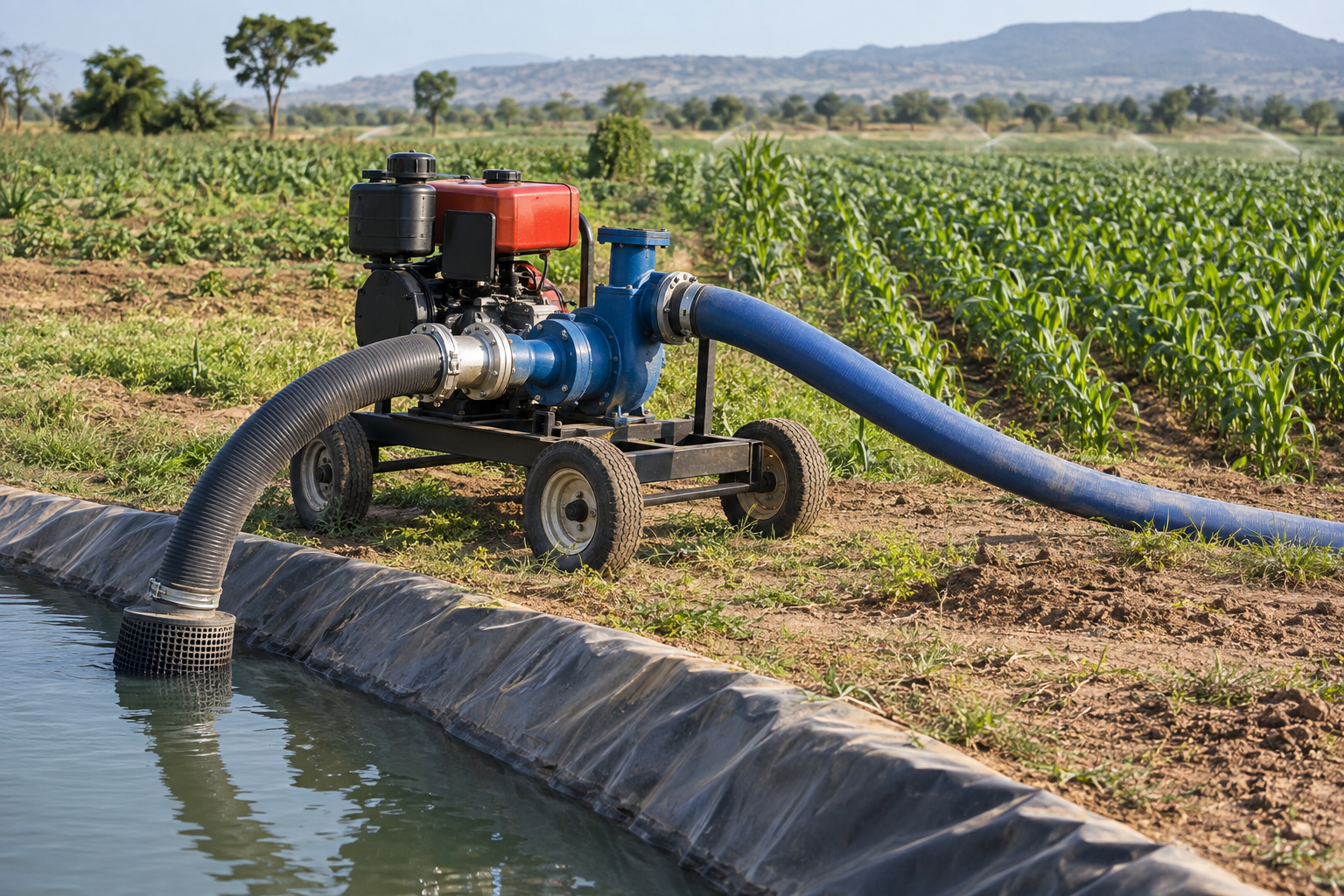
An irrigation pump should not be chosen from horsepower, outlet diameter or price alone. The pump has to deliver the required quantity of water against the resistance of the complete irrigation system. That combination—required flow at required head—is the duty point suppliers need in order to recommend a model.
This guide explains the information an international buyer should prepare before comparing irrigation pumps. It is a purchasing framework, not a substitute for site-specific hydraulic design. Confirm final sizing, electrical protection and installation with a qualified irrigation engineer or pump supplier using an actual pump curve.
Start with the duty point
Two numbers drive pump selection:
- Flow rate (Q): how much water the system must deliver per unit of time, commonly expressed in cubic metres per hour (m³/h), litres per second (L/s) or gallons per minute (GPM).
- Total dynamic head (H): the energy the pump must add to lift water, maintain operating pressure and overcome friction, usually expressed in metres or feet of water.
A quotation stating only “5.5 kW irrigation pump” is incomplete. Different pumps with the same motor power can produce very different combinations of flow and head. Ask the supplier to identify the proposed duty point on the model-specific performance curve.
Define the water source and irrigation demand
Begin with the farm, not the pump catalogue. Record the crop and irrigated area, daily water requirement, irrigation method, operating hours and the number of zones that will run at the same time. Then document the source: canal, river, pond, storage tank, shallow well or borehole.
Measure both the normal and lowest expected water levels. A source also has a sustainable yield. Pump flow should not exceed the amount a well or surface source can reliably supply, particularly during the dry season. Note seasonal sediment, leaves, sand or other solids because these influence intake protection, filtration and pump construction.
Calculate the required flow rate
A useful first estimate is:
Required flow = water volume needed during the irrigation period ÷ available pumping hours.
If a farm needs 60 m³ during a six-hour irrigation window, the average required flow is 10 m³/h. The final design must also account for peak simultaneous demand. For drip irrigation, add the flow of emitters operating in the same zone. For sprinklers, add the nozzle flows for the sprinklers running together at their required pressure.
Do not automatically add an oversized safety margin. Excess flow can increase pipe velocity, friction, energy use and pressure problems. A well-defined operating range is more useful than one inflated number.
Calculate total dynamic head
Total dynamic head is more than the vertical distance from the water to the field. A practical breakdown is:
Total dynamic head = static lift + required outlet pressure head + friction and fitting losses.
- Static lift: the vertical difference between the pumping water level and the delivery point.
- Pressure head: the pressure needed at drippers, sprinklers, filters or other equipment, converted into metres or feet of water.
- Friction loss: resistance through suction and delivery pipes, bends, valves, filters, reducers and fittings at the design flow.
Use the lowest likely source level and the actual highest delivery point. Pipe length alone does not determine friction: internal diameter, material, flow rate and fittings all matter. Ask the system designer or supplier to show the friction calculation rather than hiding it inside a vague allowance.
Choose a pump type that fits the source
| Typical situation | Common option | Points to confirm |
|---|---|---|
| Canal, pond, tank or shallow source | Surface centrifugal or self-priming pump | Real suction lift, priming method, airtight suction line, strainer and foot valve |
| Deep well or borehole | Submersible borehole pump | Bore diameter, dynamic water level, source yield, cable length, controls and sand content |
| Portable field pumping | Engine-driven self-priming set | Fuel quality, duty cycle, mobility, noise, maintenance and spare parts |
| Pressurised drip or sprinkler network | Matched centrifugal pump or multistage unit | Required pressure at design flow, filtration and control strategy |
A surface pump cannot pull water from unlimited depth. Real suction performance is affected by elevation, water temperature, pipe losses, air leakage and atmospheric conditions. For a deep borehole, a submersible pump is normally the more practical hydraulic arrangement.
Choose the power source
Electric pumps are usually convenient where a stable grid connection is available. Confirm voltage, phase, frequency, starting current, cable distance, control panel and protection against dry running, overload and voltage problems.
Diesel or petrol engine sets can work in remote or mobile applications. Compare fuel consumption at the intended duty point, tank capacity, operating hours, cooling, service intervals and local availability of filters and engine parts—not just the advertised engine horsepower.
Solar pumping systems should be sized as a complete system that includes the pump, controller, array, cabling, water storage and seasonal solar conditions. Storage tanks can often reduce the need for batteries, but the daily water requirement and pumping window still have to be modelled.
Theoretical hydraulic power can be estimated as P = 9.81 × Q × H ÷ efficiency, with Q in m³/s and H in metres. Actual motor or engine selection must include real pump efficiency, drive losses and the manufacturer’s recommended margin.
Check pipe size, connections and water quality
An undersized pipe may look cheaper but can create high friction loss and increase operating cost for the life of the system. Confirm suction and discharge diameters from the hydraulic calculation, not only from the pump port size. Include total length, elevation profile, fittings and the connection standard used locally.
Dirty water needs appropriate intake protection. Discuss strainers, foot valves, settling, hydrocyclones or filters according to the source and irrigation equipment. Clarify the acceptable particle size and concentration for the proposed pump. Also review corrosion risk, seal materials and whether the water contains fertiliser or other chemicals.
Use the pump curve—not maximum labels
A pump curve shows how head changes with flow for a particular pump and speed. Locate the required flow on the horizontal axis and required head on the vertical axis; their intersection is the duty point. The proposed pump should meet that point within the manufacturer’s recommended operating region.
“Maximum flow” is generally measured near very low head, while “maximum head” occurs near zero flow. A pump cannot normally deliver both values at the same time. Request the Q-H curve, efficiency curve, input power, required net positive suction head where applicable, impeller diameter and rotational speed for the exact quoted configuration.
A simple worked example
Assume an irrigation zone needs 60 m³ of water within six hours. The estimated design flow is therefore 10 m³/h. The vertical difference from the lowest pumping water level to the delivery point is 12 m. The irrigation equipment requires pressure equivalent to 15 m of water, and calculated pipe, filter, valve and fitting losses are 5 m at 10 m³/h.
The preliminary duty point is therefore 10 m³/h at 32 m total dynamic head (12 + 15 + 5). A buyer can send this duty point, together with water-source and power details, to suppliers and ask them to plot it on the proposed curve.
This example is deliberately simplified. A final design must validate source yield, seasonal levels, friction method, operating pressure, suction conditions and system controls.
Irrigation pump buyer checklist
- Country, farm location and elevation above sea level
- Crop, irrigated area and irrigation method
- Daily water volume and available pumping hours
- Required flow range and simultaneous zones
- Source type, lowest water level and sustainable yield
- Static lift, delivery elevation and required outlet pressure
- Pipe material, internal diameter, length and fittings
- Water quality, sand or solids, filtration and corrosion risks
- Electric supply or fuel availability
- Required controls, protection and automation
- Target duty point and complete pump curves
- Materials, seals, test records, warranty and spare parts
- Packaging, shipment, installation and commissioning support
Common purchasing mistakes
- Buying by outlet size: connection diameter does not define pump performance.
- Using only vertical lift: outlet pressure and friction can represent a large part of total head.
- Comparing maximum specifications: maximum flow and maximum head are not one operating point.
- Ignoring the lowest water level: the duty changes as a well or pond level falls.
- Oversizing without controls: this can waste energy and create unstable pressure or throttling.
- Skipping lifecycle cost: fuel or electricity, maintenance, seals, bearings, impellers and downtime can outweigh the initial price difference.
Questions to ask irrigation pump suppliers
- Which exact model meets our stated flow and total head?
- Can you mark our duty point on the pump curve?
- What are pump efficiency and input power at that point?
- What motor, engine, impeller and speed are included?
- What are the maximum recommended suction conditions?
- Which water quality and particle limits apply?
- What test report is supplied for this unit?
- Which control panel and protections are included?
- Which wearing parts should we stock for two years?
- What installation, commissioning and troubleshooting support is available?
For broader purchasing considerations, read our China agricultural machinery sourcing guide and step-by-step agricultural machinery sourcing guide.
Conclusion
A reliable irrigation pump purchase begins with a defined duty point and accurate site information. Establish the required flow, calculate total dynamic head, match the pump to the source, then compare efficiency, power supply, pipework, controls, service and lifecycle cost. This gives suppliers a common basis for quotation and makes technical differences easier to evaluate.
Send us your water source, required flow, total head, power supply, pipe details and destination country. My Supply Bridge can help identify suitable Chinese suppliers and coordinate sourcing, verification and quality control.
Sources and further reading
Once you know the required flow and head, use our diesel vs electric vs solar irrigation pump comparison to evaluate energy availability, operating cost, maintenance and storage.
After defining pump flow and head, compare drip vs sprinkler irrigation by crop, soil, pressure, filtration and field conditions.
Related articles
Planning an Irrigation Pump Purchase?
Share your duty point, water source, power supply and destination. We can help you compare suitable suppliers and configurations.
