
Diesel vs Electric vs Solar Irrigation Pumps: Which Is Best for Your Farm?
Compare initial investment, running cost, reliability, maintenance and site requirements before choosing an irrigation pump power source.
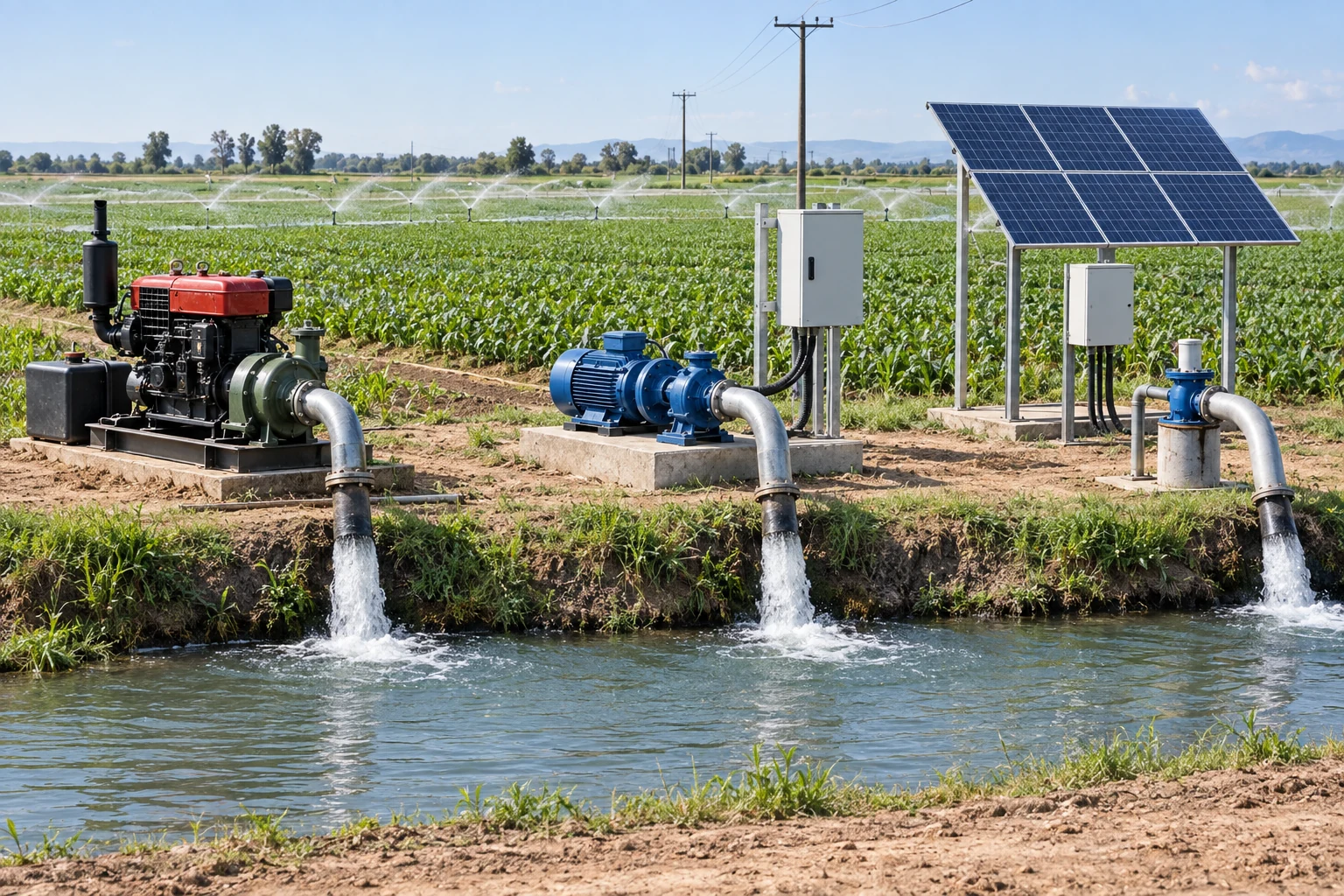
Diesel, grid-electric and solar systems can all power an irrigation pump. The best choice depends on the pumping duty, energy availability, irrigation schedule, mobility, financing and local service conditions. A low purchase price does not automatically produce the lowest cost of water.
This guide compares the three options from a buyer’s perspective. It assumes that each system is sized to deliver the same required flow and total dynamic head. For help defining those figures first, read our irrigation pump selection guide.
Compare the same pumping duty
Power-source comparisons are meaningful only when the alternatives perform the same job. Give every supplier the same duty point, daily water volume, pumping hours, water-source level, pipe layout and outlet-pressure requirement. Also define the design season: solar availability, crop demand and water level can all change during the year.
A diesel engine rating, electric motor rating and solar-array rating are not directly interchangeable. Each proposal should identify pump efficiency, motor or engine efficiency, control losses and the expected operating point on the pump curve. Compare complete installed systems rather than headline power ratings.
Diesel vs electric vs solar: quick comparison
| Factor | Diesel | Grid electric | Solar |
|---|---|---|---|
| Initial investment | Often lower for a portable set | Depends heavily on grid connection and controls | Often higher because panels, structure and controls are included |
| Running cost | Fuel, transport and routine engine service | Electricity tariff and demand-related charges where applicable | Low energy cost, but maintenance and replacements still exist |
| Operating schedule | Available when fuel and operator are available | Available when the grid is reliable | Output follows solar resource unless storage or backup is added |
| Mobility | Good for portable field use | Usually tied to a power connection | Usually a fixed installation |
| Maintenance | Engine oil, filters, cooling and fuel system plus pump | Primarily motor, controls and pump | Panels, structure, controller, wiring, sensors and pump |
| Main risk to plan for | Fuel price, fuel quality and logistics | Outages, voltage quality and connection capacity | Seasonal solar variation, water storage, security and water-resource management |
These are directional comparisons, not universal rankings. Local tariffs, fuel delivery cost, financing and equipment utilisation can reverse an apparent advantage.
When a diesel irrigation pump makes sense
A diesel engine-driven pump can be practical when the site has no dependable electricity, the equipment must move between water sources, or pumping has to start on short notice regardless of sunlight. Packaged sets are widely available and can provide high power without building a grid connection or solar array.
The trade-off is recurring fuel and engine maintenance. Buyers should calculate delivered fuel cost at the farm, not a national pump price. Include transport, secure storage, operator time, oil, filters, cooling-system service and expected overhaul or replacement. Fuel quality and spare-parts availability can be as important as rated power.
Ask for fuel consumption at the required duty point. A generic “litres per hour” figure without pump load, speed and operating point is not a reliable basis for comparison. Confirm whether the engine is intended for continuous or intermittent duty and whether derating is required for altitude or high ambient temperature.
When a grid-electric pump makes sense
A grid-electric motor pump is often attractive where the supply is stable, correctly sized and close to the water source. Electric motors generally require less routine service than combustion engines and can integrate readily with pressure switches, level sensors, variable-frequency drives and remote controls.
The complete project may still require a transformer, long cable run, control panel, protection devices and civil work. Confirm voltage, phase, frequency, permitted starting current and voltage drop at the pump. In areas with unstable voltage or frequent outages, protection and backup planning are essential.
Compare the local tariff at the expected operating schedule. A low energy rate is less valuable if irrigation cannot run during the hours crops need water. Where power is reliable and annual utilisation is high, grid electricity can offer a strong balance of initial cost, operating cost and automation.
When a solar irrigation pump makes sense
Solar pumping can suit remote farms with good solar resources, predictable daytime pumping and expensive or unreliable fuel supply. A complete solar-powered irrigation system includes the PV array, mounting structure, controller or inverter, pump, wiring, protection, sensors, pipework and often a reservoir. It is not simply a conventional pump connected to panels.
Solar systems commonly store water rather than electricity. Pumping into a reservoir during sunny hours can provide steadier irrigation later and can avoid batteries, which add cost, maintenance and replacement requirements. Direct pumping is simpler, but pressure and flow vary with solar irradiance unless the system design manages that variation.
Lower energy cost does not mean zero operating cost. Allow for panel cleaning, vegetation control, electrical inspections, pump service, security and eventual component replacement. Check array land, shading, wind loading, corrosion exposure and theft risk. Size from the most demanding relationship between seasonal water requirement and available solar energy—not from annual average sunshine alone.
Solar pumping also requires water governance. Removing fuel cost can encourage more pumping, so the design should respect the sustainable yield of the well or surface source. Include water-level monitoring, dry-run protection and agreed abstraction limits where applicable.
Consider a hybrid system when continuity matters
A solar-grid or solar-diesel hybrid can extend operating hours and provide backup during cloudy periods or peak irrigation demand. Hybrid designs may reduce fuel use while preserving dispatchable power, but they add controls, interfaces and commissioning requirements.
Define which source is primary, when the backup starts, whether both sources can operate together and how the controller prevents unsafe switching. Compare the hybrid against alternatives such as a larger reservoir, revised irrigation zones or a more efficient distribution system. More equipment is useful only when it addresses a defined operating constraint.
Compare lifecycle cost, not purchase price
FAO guidance recommends comparing pumping technologies on a common lifecycle basis because low first-cost systems often have higher recurring costs, while higher-capital systems may reduce future expenditure. Build a cash-flow comparison for the same analysis period and water output.
- Equipment, design, installation and commissioning
- Grid connection, solar structure, fuel storage or water reservoir
- Energy or delivered fuel for each operating year
- Routine labour and maintenance
- Replacement of pumps, engines, controllers and other shorter-life components
- Finance cost and applicable discount rate
- Downtime, backup operation and lost crop-production risk
- Security, insurance and end-of-life disposal
Then calculate an annualised cost or cost per cubic metre of water at the required head. Run sensitivity cases for fuel price, electricity tariff, operating hours and seasonal solar conditions. A World Bank solar-pumping guide similarly treats initial cost, operation and maintenance, energy and capital replacements as core lifecycle-cost elements.
Three practical decision scenarios
Remote field with changing water points
A portable diesel set may be the practical starting point because mobility and immediate operation matter more than automation. Compare fuel logistics and engine service carefully; a trailer-mounted electric or solar installation is not automatically equivalent.
Permanent farm with reliable three-phase power
A grid-electric pump may offer the simplest long-term operation. Confirm connection capacity, voltage quality and tariff, then consider automatic controls and variable-speed operation where the hydraulic design supports them.
Remote permanent borehole with strong daytime sun
A solar submersible system with an appropriately sized reservoir may reduce reliance on fuel deliveries. Validate seasonal water demand, dynamic water level, solar resource, array security and the pressure available from the reservoir to the irrigation system.
No scenario replaces site calculations. The same farm may also use different power sources for separate duties or retain a backup set for critical crop stages.
Information to send pump-system suppliers
- Required flow, total dynamic head and daily water volume
- Water-source type, lowest dynamic level and sustainable yield
- Irrigation method, pressure requirement and operating schedule
- Pipe length, diameter, material and elevation profile
- Site altitude, temperature, dust, humidity and corrosion conditions
- Available voltage, phase, frequency and grid reliability
- Delivered fuel price, fuel quality and local engine-service capability
- Monthly solar resource and shading information
- Need for mobility, storage, backup and automation
- Destination-country standards and documentation
- Requested pump curves, efficiency data and test reports
- Warranty, manuals, commissioning support and two-year spare-parts list
Common comparison mistakes
- Comparing unequal duties: one quotation may deliver less flow or head than another.
- Using rated power as performance: kW or horsepower alone does not define water output.
- Ignoring connection and storage: grid extension, fuel storage and water reservoirs can materially change project cost.
- Assuming solar means batteries: many irrigation systems use water storage instead, but the reservoir must be designed for the irrigation requirement.
- Assuming low energy cost means unlimited water: source yield and groundwater sustainability remain hard constraints.
- Leaving replacements out of the model: engines, pumps, controllers and other components can have different service lives.
Which irrigation pump power source should you choose?
Choose diesel when mobility, rapid deployment or independent operation justifies fuel and engine maintenance. Choose grid electric when reliable power is available and connection cost is reasonable. Choose solar when the site is permanent, solar resources are suitable and the higher initial investment can be assessed against lower energy expenditure. Consider hybrid power or water storage when continuity is the main constraint.
Whichever option you prefer, request quotations for the same hydraulic duty and compare complete lifecycle costs. For broader equipment planning, see our China agricultural machinery sourcing guide.
Send My Supply Bridge your duty point, water source, power availability, operating schedule and destination country. We can help you identify suitable Chinese suppliers and compare complete configurations.
Sources and further reading
Power-source selection is only one part of the system. Use our drip vs sprinkler irrigation guide to compare application method, pressure, filtration and maintenance.
Related articles
Comparing Diesel, Electric or Solar Pump Systems?
Share your hydraulic duty and site conditions. We can help you compare suitable suppliers and complete configurations.
