
Drip vs Sprinkler Irrigation: Which System Is Best for Your Farm?
A practical comparison of water application, pressure, filtration, crop fit, field conditions, maintenance and total system cost.
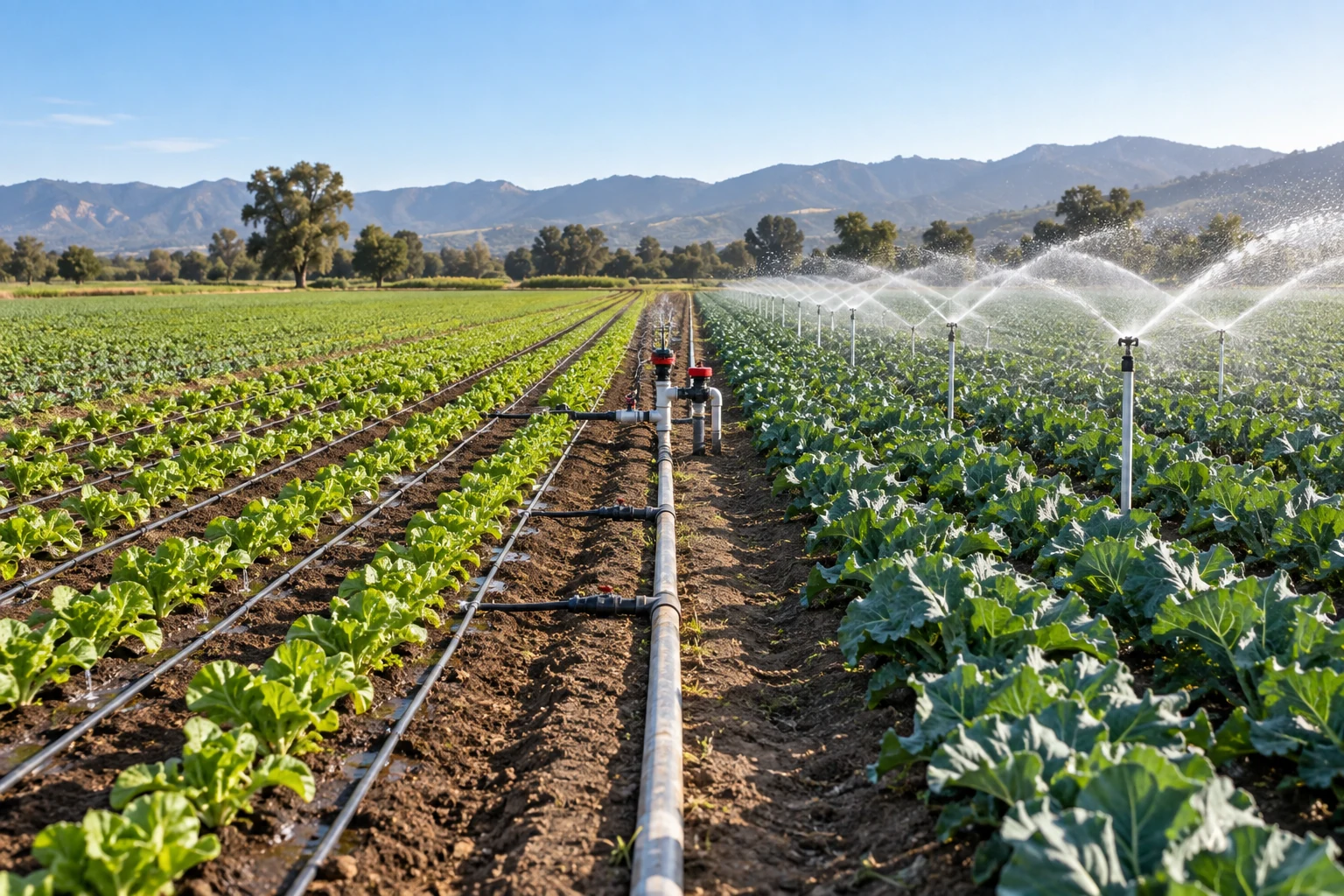
Drip and sprinkler irrigation solve different field problems. Drip applies water near the root zone through emitters or drip tape. Sprinklers discharge water into the air and distribute it over the crop and soil surface. Neither method is automatically best for every farm.
The correct choice depends on crop layout, soil, wind, water quality, pressure, field size, labour and the work the system must perform. This guide helps buyers define a suitable system before asking suppliers for quotations.
Start with the farm—not the equipment list
Before comparing components, document the irrigated area, crop spacing, root depth, growth stage, soil texture and infiltration rate. Record field dimensions, elevation changes, prevailing wind, water-source quality and seasonal supply. Then define the daily water volume and the operating window.
Also decide whether irrigation has additional jobs. Sprinklers can support crop establishment, cooling or frost protection in some situations. Drip can keep foliage and traffic lanes drier and can deliver water or nutrients to defined rows. These functions may matter more than a generic efficiency claim.
Both are pressurised systems. A complete design must divide the field into practical zones, match application rate to soil and crop needs, and maintain acceptable pressure variation throughout each operating zone.
Drip vs sprinkler irrigation: quick comparison
| Factor | Drip irrigation | Sprinkler irrigation |
|---|---|---|
| Water placement | Near plants or along crop rows | Across the crop and soil surface |
| Typical pressure need | Often lower, but pressure regulation is critical | Usually higher to create the required spray pattern |
| Wind sensitivity | Low during application | Wind can distort pattern and reduce uniformity |
| Filtration | Fine emitter openings make filtration essential | Nozzles also need clean water; requirements depend on nozzle size and source |
| Field access during irrigation | Rows and foliage can remain relatively dry | Crop and field surface become wet |
| Inspection challenge | Clogging or pressure problems may be difficult to see | Poor spray pattern is often more visible |
| Common damage risks | Rodents, tools, UV exposure and tape handling | Nozzle wear, impact damage, wind and pipe movement |
The table describes typical tendencies. Actual performance depends on design, component quality, installation, scheduling and maintenance.
When drip irrigation is a strong fit
Drip can work well for row crops, orchards, vineyards, vegetables, greenhouse production and other applications where water should be directed to a defined root zone. Because the crop canopy can stay drier, field work may continue during irrigation and some foliage-related disease pressure may be reduced.
A typical head unit includes a backflow-prevention device where required, pump, filter, pressure regulator, flow meter, valves and fertigation equipment if used. Mainlines feed submains or manifolds, which supply laterals, drip tape or emitters. Flush points are needed at line ends.
Drip is management-intensive. Small passages can clog from sediment, biological growth or chemical precipitation. Leaks, damaged tape and blocked emitters can reduce uniformity without creating an obvious visual sign. Operators need a plan for filter cleaning, line flushing, pressure checks and periodic field inspection.
Soil wetting must also be considered. Emitter spacing and flow should create an adequate wetted root volume in the actual soil. A layout that works in a heavier soil may not spread water far enough laterally in a coarse soil. Crop maturity and peak-season water demand must be included in the design.
When sprinkler irrigation is a strong fit
Sprinklers can cover closely spaced crops and fields where broad, rain-like application is useful. Options include portable sets, solid-set systems, travelling units, centre pivots and other mechanised arrangements. Nozzle size, spacing, operating pressure and layout determine application rate and pattern.
Sprinkler patterns need proper overlap. Low pressure can produce incomplete breakup and uneven coverage; excessive pressure may create fine droplets that drift or evaporate more readily. Wind speed and direction can distort distribution, so field measurements should be made under representative conditions.
The application rate must not exceed the soil’s ability to absorb water, or ponding and runoff can occur. Sprinkler selection should therefore consider soil infiltration, slope and irrigation duration rather than only throw diameter.
Sprinklers may help with germination, crop cooling or frost protection when these functions are agronomically appropriate and the system has enough capacity. They also wet foliage, which can affect disease, field access and irrigation timing. These trade-offs should be discussed with a local agronomist.
Match the system to crop, soil and climate
Crop and planting pattern
Widely spaced permanent crops often suit targeted emitters. Dense field crops may be easier to cover with sprinklers, although drip tape and subsurface drip are also used in commercial field production. Consider crop rotation: row spacing and lateral placement may change between seasons.
Soil and topography
Soil texture influences infiltration and the shape of the wetted area. Slopes create pressure differences in both systems. Pressure-compensating emitters, pressure regulation, correct lateral length and well-designed zones can help manage elevation, but they do not replace hydraulic calculations.
Wind, heat and humidity
Wind is a major sprinkler design condition because it affects droplet travel and overlap. High heat and low humidity can also increase airborne losses. Drip largely avoids wind drift, but exposed laterals can face heat and UV stress. Select materials rated for local conditions.
Match pressure zones to the pump
The irrigation method changes the required system pressure, which changes total dynamic head and pump power. Calculate the duty point from flow, static lift, required pressure and losses through pipes, valves and filters. Our irrigation pump selection guide explains this process.
Do not assume an existing pump will suit a new distribution system. A pump selected for high-pressure sprinklers may need regulation or variable-speed control when converted to drip. A low-head pump may not provide the pressure required for sprinkler throw and uniformity.
Zone size connects pump flow to field operation. Large zones shorten total irrigation time but require more flow and larger pipes. Smaller zones may reduce instantaneous demand but increase valve count, automation and operating duration. Ask suppliers to show pressure at the most hydraulically difficult outlet, not only at the pump.
Power-source choice is a separate decision. Review our diesel vs electric vs solar irrigation pump comparison after the hydraulic requirement is defined.
Plan filtration from a water analysis
Water quality affects both methods, but drip emitters are especially vulnerable because their passages are small. Test representative source water for suspended solids and other chemical or biological conditions relevant to clogging and corrosion. Open canals, rivers and ponds can change with season or rainfall.
Screen, disc, media or centrifugal separation may be considered according to the contaminant and flow. Specify the filtration level required by the selected emitter or nozzle manufacturer and size the filter for zone flow with an acceptable clean and dirty pressure loss.
Include pressure gauges or ports before and after filtration so operators can recognise rising pressure loss. Provide isolation, flushing and safe cleaning access. Fertigation equipment also needs backflow protection, chemical compatibility and operating procedures appropriate to local rules.
Compare complete installed and operating cost
Do not compare drip tape with sprinkler heads as isolated products. Build a bill of materials for the complete system:
- Pump, driver and control panel
- Intake protection and filtration
- Mainline, submain, laterals and fittings
- Valves, regulators, gauges, meters and automation
- Emitters, drip tape, sprinklers, risers or mobile equipment
- Fertigation and backflow protection where required
- Earthwork, foundations, electrical work and installation labour
- Initial spare parts, tools, training and commissioning
Then add energy, labour, filter servicing, flushing, nozzle or emitter replacement, tape retrieval or disposal, leak repair and downtime. A lower-pressure system may reduce pumping energy, but filtration and maintenance can offset part of that saving. A sprinkler system may use fewer field laterals in some layouts but require more pressure and be more sensitive to wind.
Practical decision scenarios
Row vegetables with limited water and reliable filtration
Drip may provide targeted application and drier foliage. Confirm emitter spacing, filtration, pressure regulation and a realistic tape-management plan.
Closely spaced crop requiring establishment water
Sprinklers may offer broad coverage and germination support. Check wind, nozzle overlap, application rate and available pumping pressure.
Orchard on rolling ground
Pressure-compensating drip or micro-irrigation may be suitable, but zone elevation, lateral length and root-zone coverage need calculation.
Large field with mechanisation requirements
A mechanised sprinkler system may reduce manual pipe movement, while subsurface or mobile drip may offer other advantages. Compare capital cost, field operations, maintenance skill and crop rotation over several seasons.
Information to send irrigation suppliers
- Crop, row spacing, root depth and rotation plan
- Field map, dimensions, area and elevation survey
- Soil texture, infiltration and drainage conditions
- Climate, wind and irrigation season
- Daily water requirement and available operating hours
- Water-source flow, level and laboratory analysis
- Required irrigation functions beyond routine watering
- Available pump curve, flow, pressure and power source
- Proposed zones and maximum simultaneous demand
- Target application rate and uniformity criteria
- Filtration, flushing, fertigation and automation requirements
- Local connection standards and destination regulations
- Installation, training, warranty and spare-parts support
Common purchasing mistakes
- Choosing by crop name alone: the same crop may use different systems under different soil, climate and management conditions.
- Ignoring water analysis: filtration cannot be specified reliably from “clean” or “dirty” as visual descriptions.
- Comparing component prices: pumps, filters, controls, pipes and installation may dominate total project cost.
- Using maximum spacing from a catalogue: wind, pressure and nozzle pattern determine real sprinkler overlap.
- Extending laterals without calculation: pressure loss can create non-uniform discharge.
- Forgetting maintenance access: filters, flush ends, valves and gauges must be usable after installation.
- Skipping field commissioning: measure flow, pressure and distribution before accepting the system.
Which irrigation system should you choose?
Choose drip when targeted root-zone application, drier foliage or lower operating pressure fits the crop and the farm can manage filtration and emitter maintenance. Choose sprinklers when broad coverage, crop establishment or another overhead application function is important and wind, pressure and infiltration conditions are suitable.
The final decision should be based on a field plan and hydraulic calculation, not a generic claim that one technology is always more efficient. Request comparable proposals that deliver the same crop water requirement under the same site conditions.
Send My Supply Bridge your field layout, crop, water analysis, required flow, pressure and destination country. We can help identify suitable Chinese suppliers and compare complete drip or sprinkler configurations.
Sources and further reading
- FAO: Technical handbook on pressurized irrigation techniques
- Utah State University Extension: Sprinkler and drip irrigation
- Utah State University Extension: Irrigation application uniformity
- Utah State University Extension: Irrigation water quality sampling
- USDA Economic Research Service: Pressurized irrigation systems
Related articles
Comparing Drip and Sprinkler Systems?
Share your crop, field conditions, water source and operating requirements. We can help you compare suitable suppliers and configurations.
