
How Much Tractor Horsepower Do You Need? A Practical Farm Buyer Guide
Choose tractor power from the work it must perform—not farm area or engine horsepower alone.
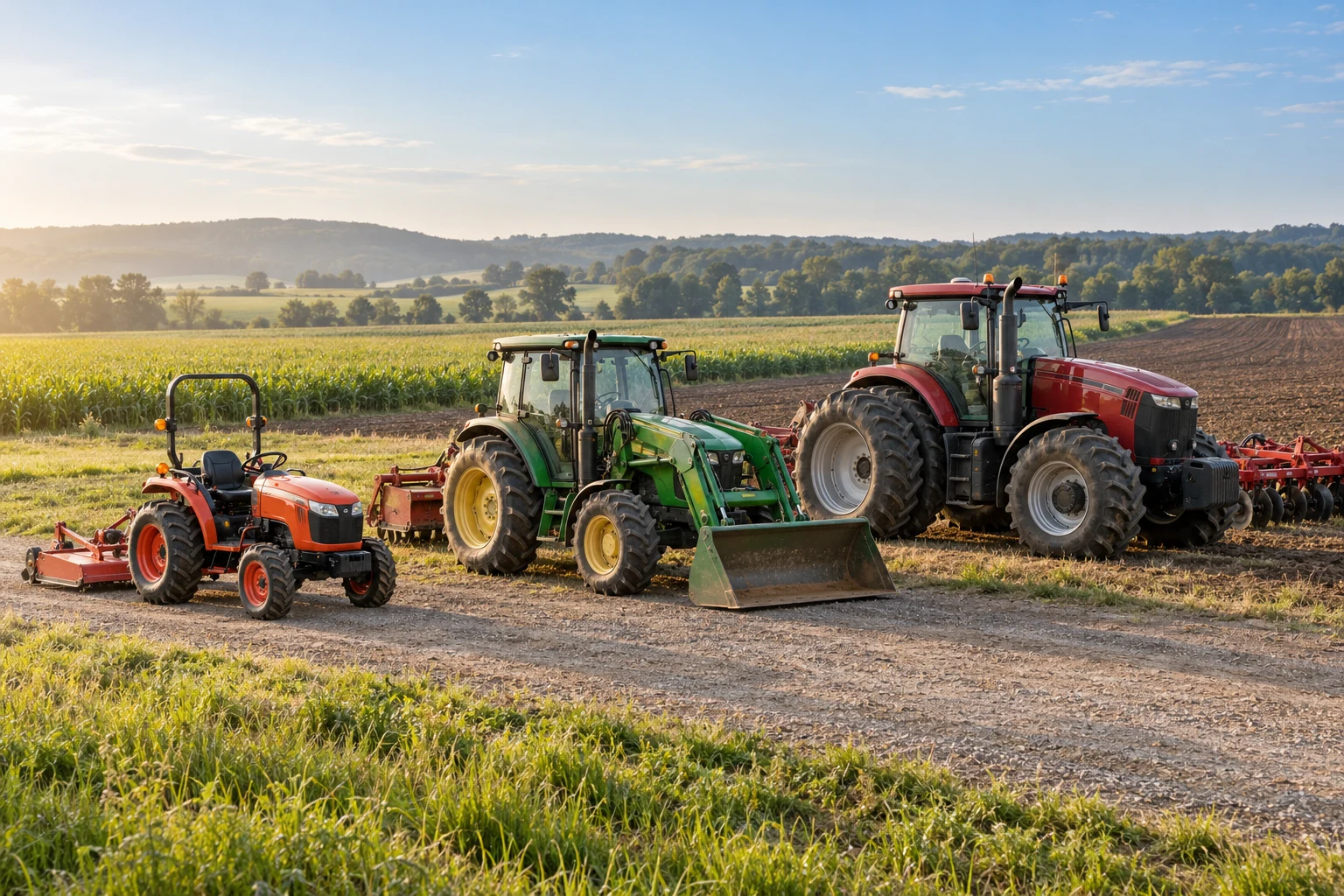
Tractor horsepower is easy to advertise and easy to misunderstand. Two tractors with similar engine ratings may deliver different usable power at the PTO or drawbar, lift different implements and perform very differently in soft soil or on slopes.
The right tractor is not simply the largest model a budget allows. It is the machine that can safely operate the farm’s critical implements, complete work within the available time and provide the required hydraulic, hitch, traction and service capabilities without carrying unnecessary weight and cost.
This guide gives buyers a practical framework for comparing tractors. Final implement matching, ballast, tyre setup and safe operation should follow the tractor and implement manufacturers’ instructions and qualified local advice.
Why farm area alone cannot determine horsepower
A 20-hectare vegetable farm using a loader, bed former and power-driven tiller can have very different power needs from a 20-hectare orchard using a narrow mower and sprayer. Farm size influences the capacity needed, but it does not describe the load.
Start by recording:
- Crops, field dimensions and row spacing
- Soil condition, slope and seasonal moisture
- Every planned implement and attachment
- Required working width and ground speed
- Available days and hours for each operation
- Transport, loader and stationary PTO work
- Operator skill, maintenance capability and future expansion
The most demanding operation may be deep tillage, baling, PTO-driven processing, lifting a mounted implement or transporting a loaded trailer. Different tasks can constrain different parts of the tractor.
Understand engine, PTO and drawbar horsepower
| Rating | What it describes | Why buyers need it |
|---|---|---|
| Engine horsepower | Power produced by the engine under the stated test or rating condition | Useful for identifying the tractor class, but not the power delivered to an implement |
| PTO horsepower | Power available at the power take-off shaft | Critical for mowers, balers, pumps, tillers, chippers and other PTO-driven equipment |
| Drawbar horsepower | Power available to pull a load through the drawbar | Relevant to ploughs, discs, rippers, planters and other towed implements |
Power is lost between the engine and the point where work is performed. Transmission, drivetrain, tyres, soil and wheel slip affect usable drawbar performance. The Penn State Extension machinery guide describes engine power as generally the highest rating, drawbar power as generally the lowest and PTO power between them.
Do not compare one supplier’s engine horsepower with another supplier’s PTO horsepower. Require each quotation to use the same rating standard and units. When kilowatts and horsepower are both used, also confirm whether values are gross, net, rated, maximum or boosted.
Start with the complete implement list
Create an implement matrix before selecting a tractor. For each tool, obtain the manufacturer’s minimum and recommended tractor power, working width, operating speed, hitch category, PTO speed, hydraulic flow, hydraulic pressure, remote-valve requirement and implement weight.
For tillage and planting equipment, draft requirement changes with implement width, speed, working depth, design and soil condition. Iowa State University Extension notes that horsepower needed to pull an implement depends on width, ground speed, draft requirement and soil condition. The supplier’s generic “suitable for 80–100 hp” label should therefore be validated against the farm and tractor type.
For PTO-driven implements, compare required PTO horsepower—not engine horsepower. Confirm 540 or 1,000 rpm, shaft size and spline, direction where relevant and whether rated PTO speed occurs at a practical engine speed. Match driveline guards, overrunning clutches and torque protection to the implement manufacturer’s requirements.
For mounted implements, power may not be the limiting factor. Three-point hitch lift capacity, lift position, front ballast, axle loading and tractor stability can determine whether the combination is usable.
Size for field capacity and available time
A tractor-implement combination must complete each operation during the available field window. Required field capacity depends on the area to cover, the number of suitable days and productive hours per day. Actual capacity is lower than theoretical width multiplied by speed because of turning, filling, adjustment and other delays.
If timely planting is critical, a wider implement and larger tractor may reduce production risk. But purchasing capacity that is rarely used increases depreciation, finance and ownership cost. The Iowa State farm machinery selection guide recommends matching tractor power and machinery size while considering the number of field days required.
Ask suppliers to show the assumed working width, speed and field efficiency behind any hectares-per-hour claim. Confirm that the tractor can maintain that speed under expected load and terrain, not only travel at that speed without an implement.
Account for traction, soil and terrain
Engine power cannot become useful drawbar power without traction. Tyre type, tyre pressure, ballast, axle loading, drive configuration and soil condition influence wheel slip and pulling ability. A powerful but poorly ballasted tractor may waste fuel, compact soil and fail to deliver its expected field performance.
Compare two-wheel drive, mechanical front-wheel drive and articulated or equal-wheel four-wheel drive according to field conditions and implement loads. Wet, soft or loose soil can require more traction capacity than firm level ground. Slopes add stability, braking and rollover considerations that cannot be solved by horsepower alone.
Follow manufacturer guidance for ballast and tyre inflation based on actual axle loads. Excess weight consumes power to move itself and may increase compaction. Insufficient weight can create excessive slip and poor control. Tracked systems may offer advantages in some conditions but add different maintenance, transport and surface considerations.
Check PTO, hydraulics and hitch compatibility
A loader, planter, air seeder, mower conditioner or other implement may be limited by hydraulic performance rather than engine power. Record:
- Total pump flow and flow available to external services
- System pressure
- Number and type of rear and front remote valves
- Power-beyond and case-drain requirements
- Three-point hitch category and lift capacity at the stated point
- Front hitch or front PTO requirements
- Electrical connectors and implement-control compatibility
Hydraulic lift figures are not always measured at the same location. A capacity stated at the lift arms can differ from capacity farther behind the hitch where the implement centre of gravity acts. Ask for the complete lift curve and confirm safe steering and stability with the intended attachment.
PTO safety is non-negotiable. The Penn State PTO safety guidance recommends using the correct driveline, keeping guards in place and stopping the engine before cleaning, servicing or adjusting PTO equipment.
Choose the transmission and speed range for the work
Gear, power-shift, continuously variable and hydrostatic transmissions serve different operating priorities. A loader benefits from easy direction changes and fine control. Tillage needs efficient power transfer under sustained load. Planting, transplanting or harvesting may require a stable, very low ground speed.
Request the real forward and reverse speed ranges at the operating engine speed. Confirm creeper gears where needed. Compare clutch type, shuttle operation, range changes, service requirements and operator training. Ease of use can improve productivity, but the transmission must still deliver the usable power and speed control required by the implements.
If transport is important, check road speed, braking, trailer-brake connections, lighting, tyre rating and local road rules. A faster maximum speed is not useful if the combination cannot stop or operate legally.
Choose a sensible operating margin
A tractor should not be selected to operate continuously at the edge of its capability, but an arbitrary large horsepower margin is not a substitute for calculations. Allow for realistic peak loads, altitude or temperature derating where specified, component ageing and modest future needs.
Oversizing has costs: higher purchase price, greater weight, potentially larger implements, more storage space and sometimes higher fuel use at light loads. Undersizing can reduce field capacity, increase slip, overload components and leave insufficient PTO or hydraulic reserve.
Define future expansion specifically. “We may need more power” is vague; “we plan to move from a 2.0 m to a 2.5 m rotary tiller within three years” can be checked against real specifications.
How to compare tractor quotations
Request an itemised, model-specific quotation rather than a general catalogue. Use the same implement list and operating conditions for every supplier.
| Comparison item | Evidence to request |
|---|---|
| Power ratings | Rated and maximum engine power, PTO power, drawbar data where available, test standard and engine speed |
| Engine | Displacement, aspiration, emissions configuration, fuel system, cooling and altitude/temperature information |
| Transmission | Type, gears or ranges, creeper speeds, shuttle and real speed chart |
| PTO | Speeds, shaft options, engagement, guards and PTO horsepower |
| Hydraulics | Pump type, total and remote flow, pressure, valve count and lift curve |
| Hitch and drawbar | Categories, dimensions, lift capacity, stabilisers and approved loads |
| Traction | Drive type, tyres, axle capacities, ballast options and differential locks |
| Safety and operator station | ROPS/cab, seat belt, brakes, lighting, guards, controls and applicable certification |
| Support | Manuals, diagnostic tools, warranty route, training and spare-parts availability |
Where independent test reports exist, use them to compare claims. The Nebraska Tractor Test Laboratory publishes official tractor test reports, and OECD Code 2 covers measured tractor performance including drawbar results under defined test conditions.
Inspect the exact configuration before shipment
Verify the model, engine, transmission, axles, PTO, hydraulic valves, hitch, tyres, ballast, cab and accessories against the approved order. Check identification plates and serial numbers and record them in the inspection report.
A practical inspection can include cold starting, idle and rated-speed operation, warning indicators, steering, brakes, clutch or shuttle, gear selection, PTO engagement, three-point lift, hydraulic remotes, lights, leaks and abnormal noise. Functional testing should be performed safely by qualified personnel with appropriate equipment and guards.
Confirm tools, manuals, filters, belts, seals, wearing parts and optional attachments. Review preservation, loose-component identification, container securing, reassembly instructions and fluid requirements at destination.
Tractor horsepower buyer checklist
- Country, farm location, altitude and climate
- Farm area, field dimensions, slopes and soil conditions
- Crop plan and available field-work windows
- Every implement with model, width, weight and working speed
- Required engine, PTO and drawbar performance
- PTO speed, shaft and driveline requirements
- Hydraulic flow, pressure, remotes and lift capacity
- Hitch, drawbar and electrical-interface compatibility
- Drive type, tyres, ballast and axle-load requirements
- Transmission, creeper speed and shuttle requirements
- Loader, transport and stationary-power duties
- Safety, emissions and destination-country requirements
- Independent test data and model-specific documents
- Warranty, manuals, training and two-year spare-parts plan
- Inspection, packaging, shipping and commissioning scope
Common tractor-selection mistakes
- Buying by farm area: area does not define implement load or available working time.
- Comparing engine horsepower only: PTO and drawbar performance may be the actual constraints.
- Ignoring implement weight: hitch capacity, axle load and stability can limit a combination before power does.
- Checking hydraulic pressure but not flow: both matter for implement speed and performance.
- Choosing excessive horsepower: unnecessary capital, weight and operating cost do not improve every task.
- Forgetting slow-speed work: some planters, transplanters and harvesters need a suitable creeper range.
- Assuming attachments are compatible: hitch, PTO, hydraulic and control interfaces require written confirmation.
- Skipping parts planning: a tractor without filters, wearing parts, manuals and service support can create costly downtime.
Match the tractor to the complete farm system
Choose tractor horsepower from the most demanding implement and required field capacity, then verify PTO, drawbar, hydraulics, hitch, traction, transmission and safety. Farm area is only one input.
Give suppliers a common implement matrix and ask for model-specific performance evidence. The best tractor is the one that completes the required work reliably and safely without paying for power or weight the farm cannot use.
For wider procurement planning, read our China agricultural machinery sourcing guide and agricultural machinery sourcing guide.
Send My Supply Bridge your farm conditions, crop, implement list, required capacity and destination country. We can help identify suitable Chinese suppliers and compare complete configurations.
Sources and further reading
- Iowa State University Extension: Farm machinery selection
- Iowa State University Extension: Fuel-efficiency factors for tractor selection
- Penn State Extension: Managing machinery and equipment
- Nebraska Tractor Test Laboratory: Official test reports
- OECD Standard Code 2 for tractor performance testing
Related articles
Looking for a Tractor and Matching Implements?
Share your farm conditions, implement list and required capacity. We can help you compare suitable suppliers and configurations.
